Tuesday, 27 May 2014

New Born Kittens Development - Week 2

By now you should have noticed that your newborn kittens are developing at a very fast pace. I have also noticed kittens starting grooming themselves. At two weeks at least 4 things become more prominent:

1. Growth - Kittens are continuing their growth at a very fast rate (around 10 grams per day). 

2. Eyes development - Their eyes have started to open and will be completely open at 9 to 14 days old or so. All kittens' eyes are blue, and will remain so for several weeks. Their vision will be blurred at first, and their pupils don't dilate and contract readily, so they should be protected from bright lights. 

3. Sense of Smell - The kittens' sense of smell is developing, and they might even hiss at unfamiliar odours.

4. Sex - You might be able to determine the sex of the kittens around this time.

Friday, 16 May 2014

New Born Kittens Development - Week 1

During the first week of a kitten's life he will be concentrating on feeding and growth. At this point you might be asking yourself a few questions, here are a few answers that might help:

1. When will the new born kittens open their eyes? By the second week their eyes will begin to open although their vision will not be very clear at this stage. Do not force their eyes open as it could result in damage. All kittens have blue eyes at this stage.

2. When will the umbilical chord fall off? The umbilical cord should fall off within two or three days, but it could also take up to a week or so. However their eyes and ear canals will not be open yet.

3. When should I get my kitten vaccinated? Provided the mother has been vaccinated, or has natural immunity, the kittens will receive the same immunity for the first 24-48 hours through her colostrum (first milk). They will need to receive a vaccination course at 9 and 12 weeks. 

4. Should I let other animals near the new born kittens? Animals can be unpredictable, I have heard of male cats damaging new born kittens, so the short answer is NO.

Saturday, 26 April 2014

4 Helpful Tips For Cat Owners

I have always had cats but I love my British Blue kittens, they are really affectionate and considerate cats. Here are a few things I've observed as a British Blue Shorthair cat owner and would like to share with you. I am by no means a cat expert, I am however a good observer and hope these tips will help you.

1. What gets rewarded gets repeated. I've noticed that this can be true even for cats. You can encourage your cat to use the cat scratcher (instead of the sofa or wallpaper) merely by stroking him while using it and using affirming words such as "Good boy Muffin!" with a pleasing tone. I've noticed that, contrary to what people think, your cat does want to please you.

2. Clip those claws. I have also noticed that my cats scratch less when their claws are shorter. You can clip your cats claws if you want - just make sure you only clip the transparent part of their nails not the opaque area otherwise you might hurt them and cause bleeding.

3. Fun doesn't have to cost money. Muffin's favourite toy is a paper ball and he loves to play catch. I use paper balls to play with my kittens and they love it. Fun doesn't have to cost money and even a piece of string can turn a boring evening into fun for all.

4. Call them by name before dinner. Call them by their names so they can get used to it and actually respond. I also make a distinctive 'pssssh, psssh, psssh' sound when I serve them food in order for them to associate the sound with dinner. This also helps when you simply want them to come to you just for fun. Make sure you also reward them every now and then with treats as what gets rewarded gets repeated.

Friday, 3 January 2014

Why Does My Cat Have Whiskers?

Elaborate Sensory Devices
Whiskers are extraordinary sensory devices that help your cat interact with the world. They go deeper into your cat's skin and connect with many more nerve endings. Whiskers are very sensitive to touch and vibrations and tell your cat a lot about the size and shape of objects in the dark, they are pathways that carry information to your cat's brain in  the same way that fingers do to humans. Never cut or remove them as your cat needs them, without their whiskers a cat may become disoriented or insecure. Whiskers fall out and re-grow naturally

Mood Detector
Whiskers can also help to identify your cat's mood.
Relaxed and sticking out sideways = Your cat is calm.
Pushed forward = They are excited and alert.
Flattened against their cheeks = Angry or scared

Strategically Positioned
You will find whiskers on the side of your cat's cheeks, further back on the cheeks and above the eyes. They are as long as the width of their bodies, which help gauge the width of openings in the dark. Whiskers above the eyes send signal to the brain providing blinking reflexes so that your cat can close their eyes quickly in order to prevent something from entering their eyes. Legs whiskers help your cat with prey detection and facilitate safe landing.

Saturday, 31 August 2013

British Shorthair - 10 Things You Should Not Do

1 - Do not let you cat run out of fresh clear water. Serve water preferably in a stainless steel or crockery bowl as plastic can cause acne and greasy chins.
2 - Do not make any sudden unnecessary changes to your kitten diet as it could cause problems such as digestive disorders.
3 - Do not give your cat or kitten milk - it will give them the runs.
4 - Do not punish a new kitten for an 'accident'. This only increases the youngster's anxiety and the likelihood of it happening again.
5 -  Do not put the kitten's litter tray near its food or in a busy area. Choose a permanent quiet area away from noise.
6 - Do not expose your cat to the following: Lilies, (exposure can cause fatal kidney damage), grapes and raisins (can cause kidney damage), onions, tomatoes and mushrooms (can also cause problems), raw fish (too much raw fish can cause health problems), liver (too much liver can overload the their system with vitamin A and cause bone problems).
7 - Do not leave plastic bags, foam, open dustbin, iron or any dangerous objects around.
8 - Do not give table scraps during your meal or the kitten will get used to begging and stealing from the table.
9 - Do not adopt a kitten under 2 months. They will be more fragile and difficult to educate.
10 - Do not use human shampoo when washing your kitten - it may be toxic for them.

Saturday, 13 July 2013

British Shorthair - 10 Things You Should Do

1 - Spend plenty of time cuddling your kitten - it will help them grow up into a confident, sociable and affectionate adult.
2 - Get some toys to keep your kitten amused and fit.
3 - If something is worrying you, contact your vet.
4 - Make sure your kitten is introduced to human interaction as early as possible.
5 - Do get a scratching post.
6 - Combine wet and dry food and ample supply of water.
7 - If you have other animals remember introductions should be made slowly. You can also wipe the kitten's cheek or forehead with a cloth and rub their facial secretions along the bottom of the walls in other rooms so that other animals become used to their smell.
8 -  Watch out for household dangers such as, electric wires, electric sockets, cleanig products, pesticides, small objects such as pins and elastic bands, poisonous flowers such as lilies, holly, sweet peas, ivy, wisteria, mistletoe, azalea...
9 - Place suitable covers on electric hot plates or stove.
10 - Get your kitten its own sleeping basket.

Sunday, 7 July 2013

The Colourpointed

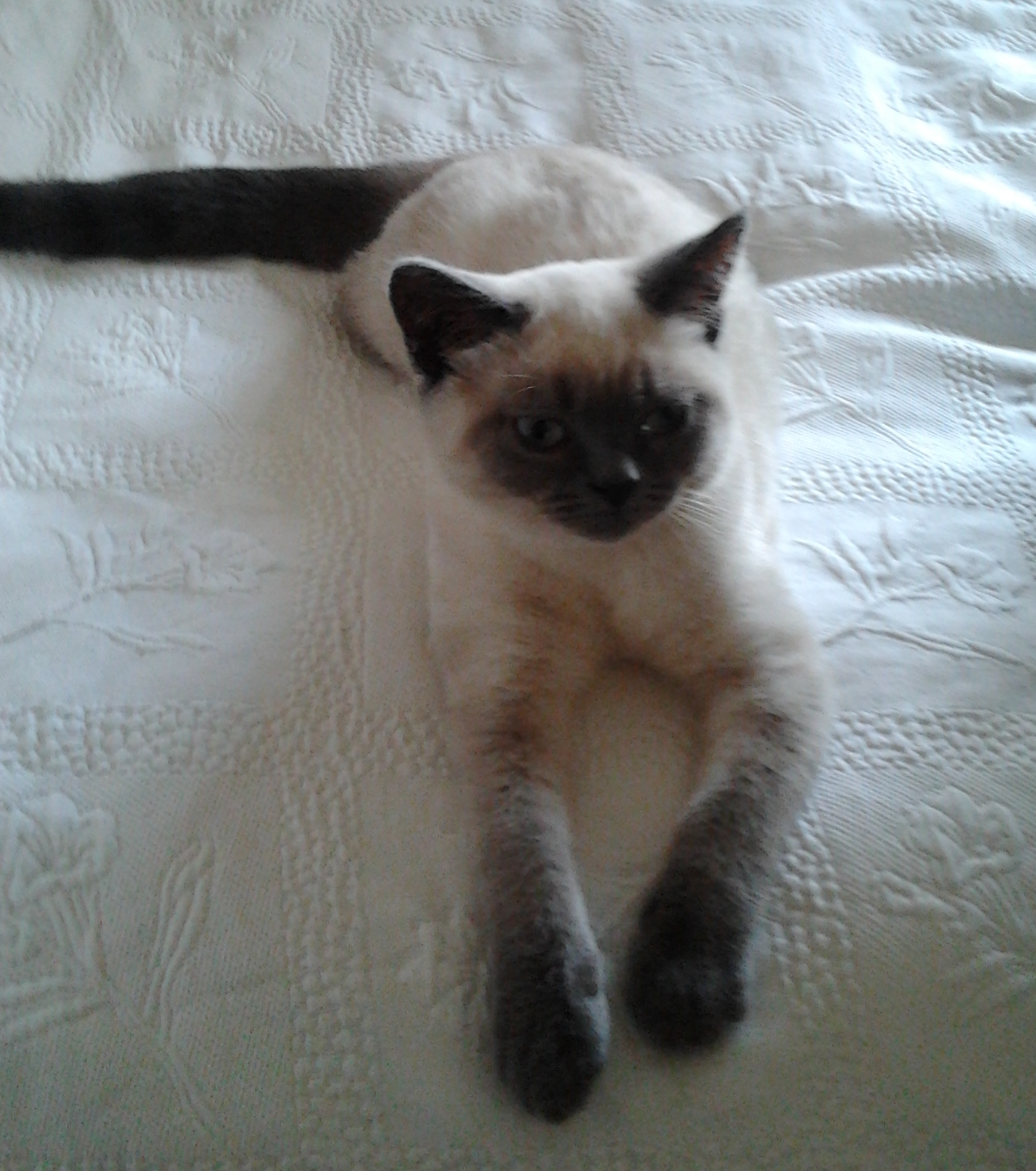
Muffin is a pedigreed Blue Colourpointed British Shorthair. The Colourpointed cats have British type with a Siamese pattern; their faces, ears, legs and tails are of a contrasting colour to that of their bodies.